The Messy Middle of Company Growth
Growth has an awkward middle. From the simple beginnings, where everyone knows who owns what, to the complex middle, where decisions are made across teams and systems.
24. August 2026 · SypraSAM Team
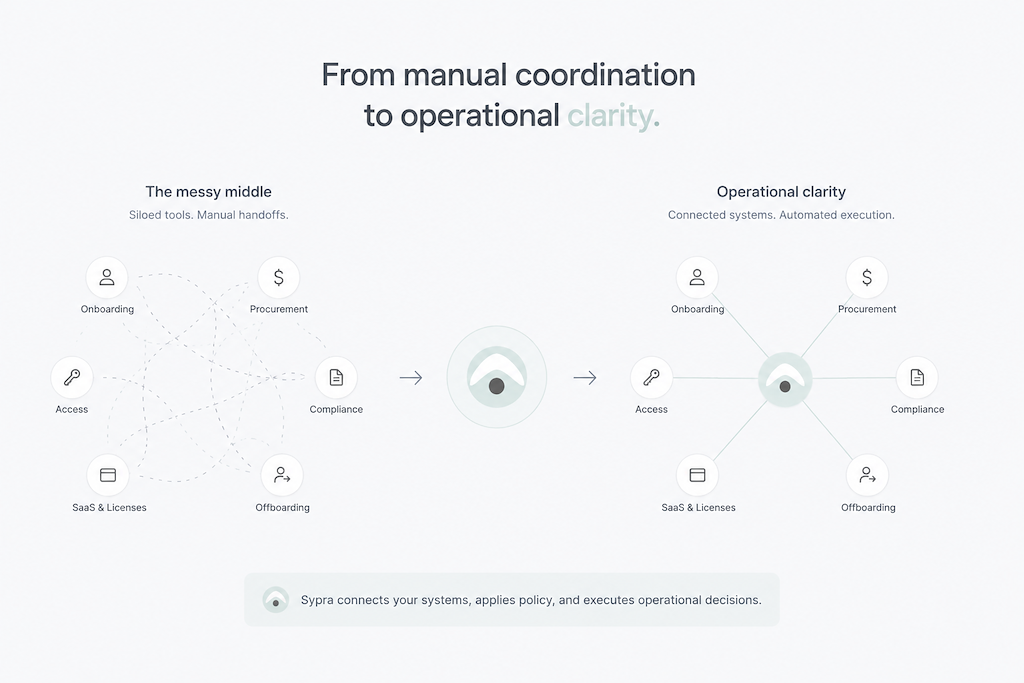
The Messy Middle of Company Growth
When growth starts creating more overhead than leverage
Growth has an awkward middle.
In the beginning, companies run on proximity. People know who owns what. A new employee needs access, someone sends a message. Software needs approval, Finance gets asked. Someone leaves, IT knows what to switch off.
Then the company grows.
There are more people, more tools, more responsibilities and more decisions. What used to take one message now moves between teams, systems and approvals.
And yet, everything still seems to work.
That is often where the problem begins.
Welcome to the messy middle
There is a stage somewhere between “everyone knows what’s going on” and “we have a proper system for this.”
At 20 people, it might be:
“Ask whoever handles IT.”
At 50:
“I think Finance needs to approve that first.”
At 100:
“Who actually owns this?”
There is no exact headcount where things become complicated. Complexity accumulates quietly: another tool, another approval, another spreadsheet, another process that depends on someone remembering what happens next.
Eventually, the company has grown faster than the way it operates.
When people become the infrastructure
Most growing companies already have plenty of software. Microsoft 365, an HR system, finance software, ticketing, SaaS platforms.
The trouble often lives between them.
When an employee leaves, HR knows. IT needs to remove access. Someone needs to check their software licences. Finance or Procurement may need to act. Each individual system can work perfectly well while the process between them remains entirely human.
So people fill the gaps. They remember tasks, find information, send messages, chase approvals and move information from one place to another.
Good people can keep imperfect operations running for a surprisingly long time. But eventually, that invisible work starts showing up somewhere else: in time and money.
The hidden cost of keeping it all together
Some costs are easy to spot: unused licences, unnecessary seats, overlapping software or contracts renewing without much scrutiny.
Others are almost invisible.
Nobody sends an invoice for the twenty minutes spent finding information before approving a request. Or the messages between three departments to establish who owns something. Or the spreadsheet someone updates every Friday because no system does it automatically.
Those costs disappear into people's working hours.
For a large enterprise, a certain amount of operational inefficiency can be absorbed. Growing companies have less room for it. Money and time spent maintaining unnecessary complexity compete directly with hiring, product development, sales and expansion.
Growth should create leverage. At some point, unmanaged growth starts creating overhead instead.
Adding more isn't always the answer
The natural response to operational complexity is often to add something: another person, another tool, another dashboard.
Sometimes that is necessary. But every new system also brings another source of information, another owner, another contract and another place somebody needs to check.
At some point, the better question is not what else should we add?
It is why does this still require a person to coordinate it?
Recurring operational decisions should gradually become part of the company's infrastructure. Known rules can be applied consistently. Systems can coordinate actions. People can focus on exceptions and decisions that genuinely require judgement rather than repeatedly rebuilding the same process by hand.
A way out of the messy middle
Operational maturity does not have to mean more bureaucracy.
It can simply mean fewer things depend on somebody remembering that “this is how we usually do it.”
This is the gap SypraSam is being built to close.
SypraSam works across the systems companies already use, coordinating recurring operational decisions across areas such as software and licences, access, onboarding and offboarding, and procurement. The goal is not to introduce another place employees need to manage, but to reduce the manual coordination happening between the places they already have.
Every growing company will become more complex. That part is unavoidable.
Paying for every increase in complexity with more administration, more meetings and more manual work is not.
The messy middle may be a natural stage of growth. Staying there doesn't have to be.
Text and image have been created with the help of AI.