Why Software Spend Is Becoming a Board-Level Problem
Software spend has evolved from a simple IT procurement task into a critical board-level concern because of the complex financial, operational, and compliance risks associated with decentralized SaaS and cloud adoption. To address this, modern organizations must shift from static spreadsheets to continuous, data-driven intelligence that connects software usage directly to business value and corporate governance.
June 18, 2026 · SypraSAM Team
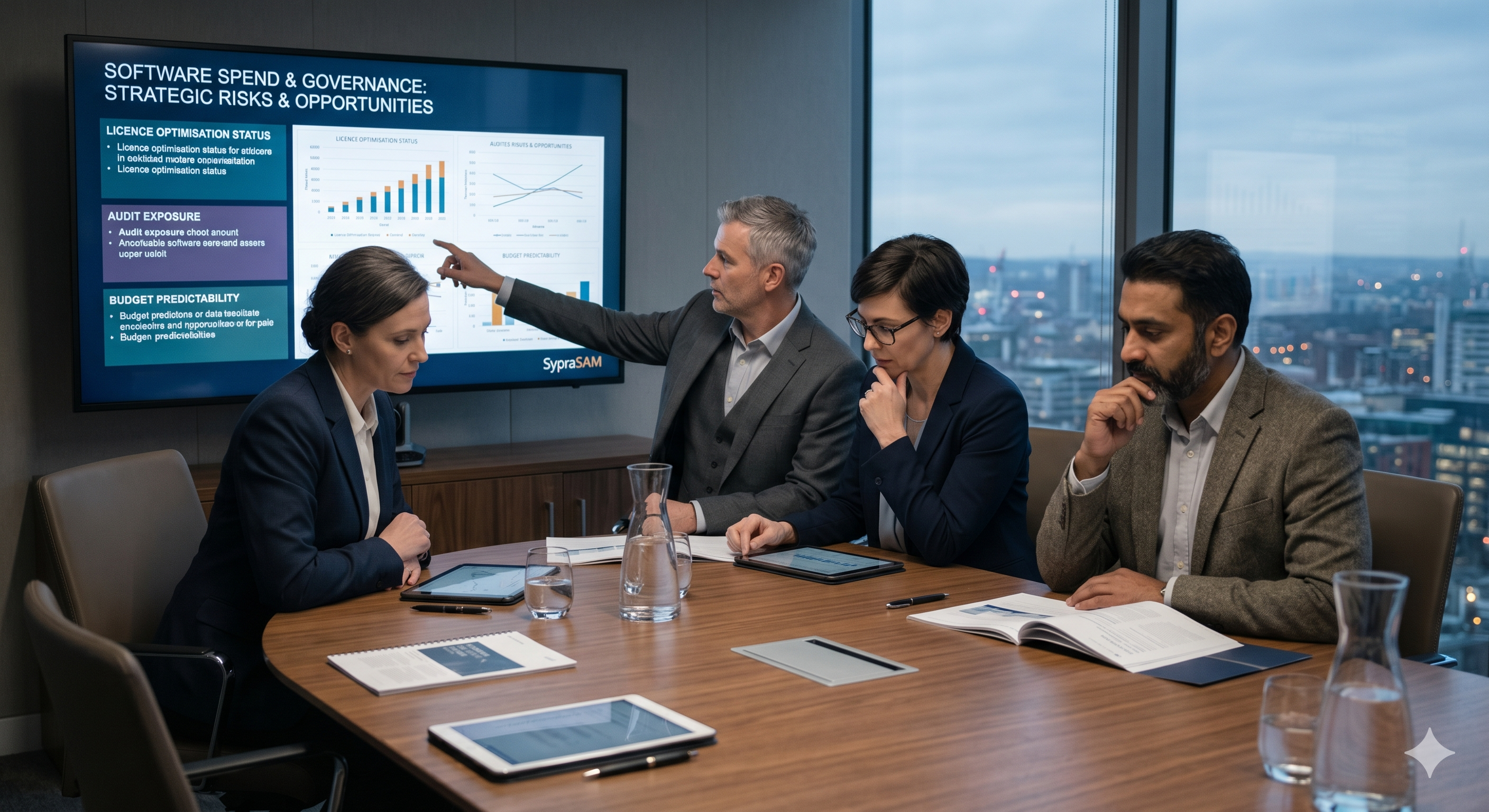
Software used to be easier to control.
A company bought licences, IT assigned them, procurement tracked renewals, and finance reviewed the invoice. It was not perfect, but the process had clear ownership.
That world has changed.
Today, software sits everywhere. It is in Microsoft 365, cloud platforms, SaaS tools, developer environments, security systems, collaboration apps, project tools, finance platforms, HR systems, and department-owned subscriptions. Some of it is centrally managed. Some of it is purchased by teams. Some of it grows quietly in the background.
The result is a new challenge for modern businesses: software spend is no longer just an IT issue. It is now a financial, operational, and compliance risk.
The Hidden Cost of Modern Software
Most organisations do not overspend on software because they are careless.
They overspend because software has become difficult to see.
- A user changes role but keeps the same licence.
- A project ends but the cloud resources continue running.
- A department buys a tool that already exists elsewhere.
- A contractor leaves but access is not removed immediately.
- A premium plan is assigned when a standard plan would be enough.
- A vendor renewal arrives before anyone has checked actual usage.
Individually, these issues can look small. Across hundreds or thousands of users, multiple vendors, and different regions, they become expensive very quickly.
The biggest problem is that many organisations only discover this waste during renewal discussions, budget reviews, or vendor audits. By then, the business is reacting rather than controlling.
Why Spreadsheets Cannot Keep Up
Spreadsheets still play a role in many software asset management processes. They are familiar, flexible, and easy to share.
But they were never designed to manage a fast-moving software estate.
Software usage changes daily. Employees join, move, and leave. Devices are replaced. Cloud workloads scale up and down. SaaS platforms add new features and pricing models. Vendor rules change. Business units make decisions without always involving central IT.
A spreadsheet can capture a snapshot. It cannot provide continuous control.
That creates a gap between what the business thinks it owns, what people are actually using, and what the organisation is contractually allowed to use.
For finance leaders, that gap creates cost uncertainty.
For IT leaders, it creates operational complexity.
For compliance teams, it creates risk.
The New Question: Who Owns Software Accountability?
One of the reasons software spend is hard to manage is that no single team owns the full picture.
- IT can see users, devices, and systems.
- Procurement can see contracts and renewals.
- Finance can see spend and budgets.
- Security can see access and risk.
- Department leaders can see business demand.
- DevOps and cloud teams can see consumption.
Each team has part of the truth, but not the whole truth.
This is why software governance needs to become more connected. Organisations need a shared view that brings together entitlement, usage, cost, risk, and accountability.
Without that shared view, teams end up debating data instead of making decisions.
From Licence Counting to Continuous Intelligence
Traditional software asset management often focused on counting licences and preparing for audits. That is still important, but it is no longer enough.
Modern organisations need to answer better questions:
- Are we paying for software that is not being used?
- Are users assigned the right level of licence for what they actually do?
- Are we exposed to compliance risk in any vendor estate?
- Are cloud and SaaS costs growing faster than business value?
- Can we prove our position if a vendor challenges us?
- Can we identify savings before the next renewal?
These questions cannot be answered properly once or twice a year. They need continuous intelligence.
Continuous intelligence means using live data from the systems the business already depends on: identity, device management, procurement, IT service management, HR, finance, and cloud platforms.
It allows organisations to move from reactive clean-up to proactive control.
Why This Matters to the Board
Software is now too material to be treated as a back-office issue.
For the board and executive team, poor software governance can affect:
- Operating costs
- Cash flow predictability
- Audit exposure
- Cybersecurity risk
- Supplier negotiation power
- Transformation budgets
- Investor and stakeholder confidence
When software data is fragmented, executives cannot easily understand where money is being wasted, where risk is increasing, or where action is needed.
A clear software intelligence strategy gives leadership better control. It helps connect technology usage to business value and turns software management into a measurable financial discipline.
What Good Software Governance Looks Like
Good software governance does not mean slowing the business down.
It means giving teams the freedom to use the tools they need, while making sure spend, access, and compliance remain under control.
A strong approach should include:
- Clear visibility of software ownership and usage
- Accurate mapping between entitlements and consumption
- Regular identification of unused or over-assigned licences
- Early warning of compliance risks
- Better evidence for renewals and audits
- Shared reporting for IT, finance, procurement, and executives
- Automated workflows when action is required
This is not just about saving money. It is about making better decisions with better data.
The Opportunity Ahead
The companies that manage software well will have a real advantage.
- They will enter vendor negotiations with evidence.
- They will reduce unnecessary spend before it becomes normalised.
- They will avoid last-minute audit panic.
- They will connect cloud and SaaS consumption to business value.
- They will give executives the confidence to invest, optimise, and govern at the same time.
- The companies that do not will continue to pay for uncertainty.
How SypraSam Helps
SypraSam was built for this new reality.
It helps organisations bring together software asset management, FinOps, DevOps visibility, and compliance governance into one intelligence-led approach. Instead of relying on static reports and manual reviews, SypraSam helps businesses understand software usage, licensing risk, optimisation opportunities, and audit readiness on a continuous basis.
For organisations looking to reduce waste, improve control, and make software spend more transparent, the first step is visibility.
The next step is intelligence.
That is where SypraSam helps.